
By Emmanuel Iyede | The Bureau Journal
Today, discussions about Nigeria’s economy often revolve around external borrowing, debt servicing, fiscal deficits and negotiations with international financial institutions such as the World Bank and the International Monetary Fund (IMF).
For many young Nigerians, it may come as a surprise that there was a time when the country’s economic fortunes were so strong that the World Bank itself borrowed money from Nigeria.
It sounds unbelievable in today’s economic climate, yet it is a well-documented historical fact.
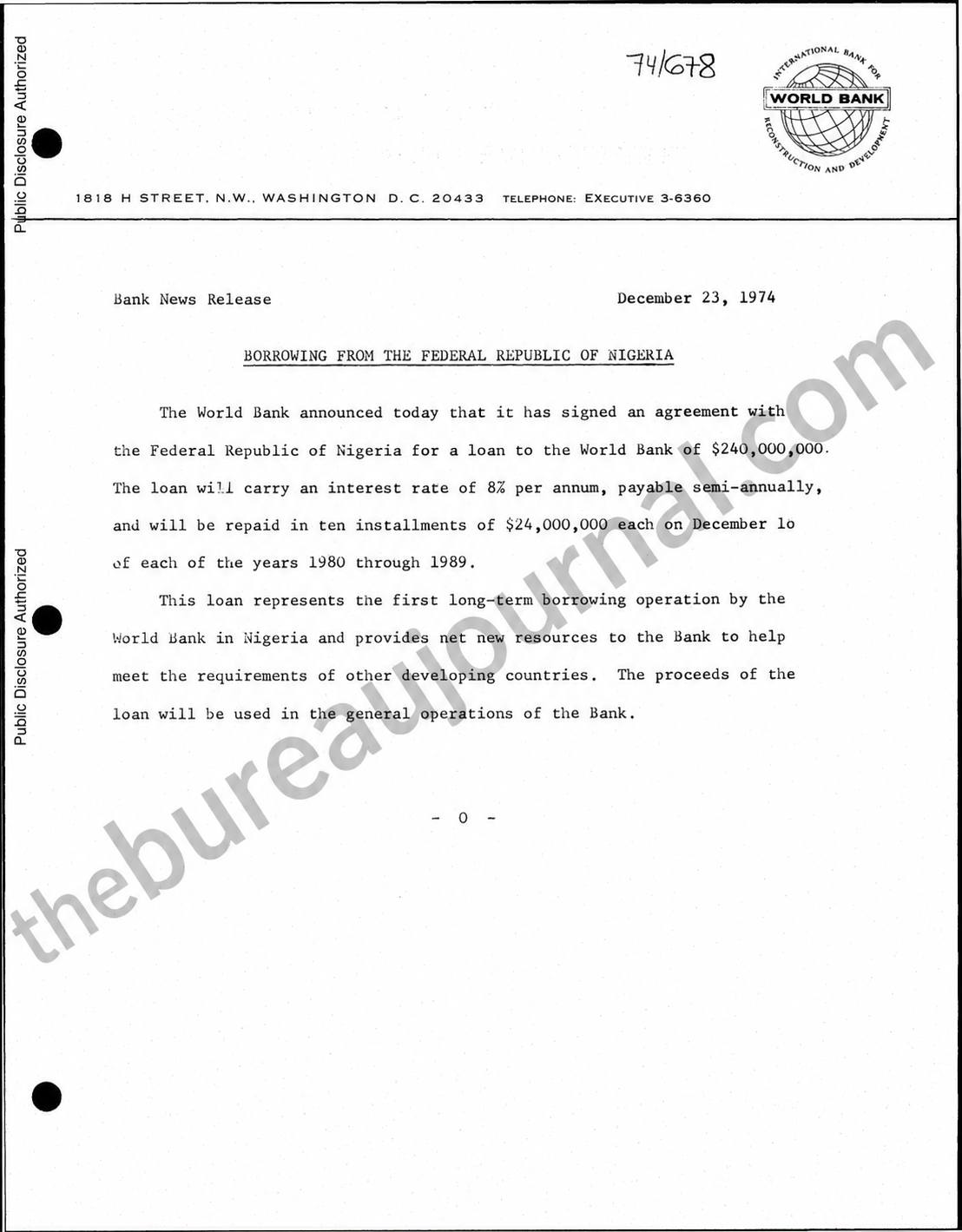
On December 23, 1974, the World Bank officially announced that it had signed a $240 million loan agreement with the Federal Republic of Nigeria. The funds were not for Nigeria’s development; instead, they were intended to support the World Bank’s lending programme to finance development projects in other countries.
The announcement was contained in an official World Bank press release titled “Borrowing from the Federal Republic of Nigeria.” The agreement remains one of the most remarkable but least discussed moments in Nigeria’s economic history.
More than five decades later, the story serves as both a historical lesson and a reminder of how dramatically Nigeria’s economic fortunes have changed.
When Nigeria Was Among the World’s Financial Powerhouses
To understand why the World Bank approached Nigeria for a loan, it is important to revisit the country’s economic position in the early 1970s.
Following the end of the Nigerian Civil War in 1970, the country entered a period of rapid economic expansion driven largely by the global oil boom.
Crude oil prices surged after the 1973 Arab oil embargo, leading to an unprecedented increase in Nigeria’s petroleum revenues.
As one of the world’s major oil-producing nations, Nigeria suddenly found itself earning far more foreign exchange than it had anticipated.
Government coffers expanded rapidly, foreign reserves grew significantly, and the country became one of Africa’s strongest economies.
It was during this period that Nigeria embarked on massive infrastructure projects, invested heavily in education, transportation, healthcare and industrialisation, while also increasing its influence in African and international affairs.
Unlike today, Nigeria was not seeking emergency financial assistance from international lenders. Instead, it had become a country with surplus capital looking for productive international investments.
Why Did the World Bank Borrow from Nigeria?
The World Bank, formally known as the International Bank for Reconstruction and Development (IBRD), finances development projects around the world by raising funds from capital markets and member countries.
During the 1970s, oil-exporting nations accumulated enormous financial surpluses because of soaring crude oil prices.
Rather than allowing these resources to remain idle, international financial institutions sought to mobilise part of the surplus to finance development programmes across developing nations.
Nigeria was one of the countries with substantial foreign exchange reserves, making it an attractive source of funding.
Consequently, negotiations between Nigeria and the World Bank culminated in the landmark loan agreement signed in December 1974.
Far from being a bailout or aid package, the transaction reflected confidence in Nigeria’s financial strength and creditworthiness at the time.
The Historic $240 Million Agreement
According to the World Bank’s official records, Nigeria agreed to lend the institution $240 million.
The agreement contained several notable provisions:
- The loan attracted an annual interest rate of 8.7 percent.
- Interest was payable every six months.
- The principal was to be repaid in 10 annual instalments of $24 million each.
- Repayment was scheduled to begin in 1980 and conclude in 1989.
- The funds were designated for the World Bank’s general lending operations in developing countries.
These terms demonstrated that Nigeria was not making a donation. It was entering into a commercial financial arrangement expected to generate returns while contributing to global development financing.
A Symbol of Nigeria’s Economic Confidence
The significance of the 1974 agreement extended beyond the amount involved.
At the time, it sent a powerful message to the international financial community that Nigeria had emerged as a financially stable nation capable of supporting multilateral development institutions.
Few developing countries possessed sufficient financial reserves to lend hundreds of millions of dollars to one of the world’s largest development banks.
Nigeria’s participation reflected both its growing economic influence and the confidence international institutions had in its financial capacity.
For many economists, the agreement represented one of the high points of Nigeria’s post-independence economic history.
A Forgotten Piece of Nigerian History
Despite its historical importance, relatively few Nigerians are aware that their country once occupied the position of lender rather than borrower.
Today’s public discourse is largely dominated by discussions about sovereign debt, external borrowing and debt servicing obligations.
As a result, the period when Nigeria provided financial support to global institutions has gradually faded from public memory.
Yet official archival documents leave little room for doubt.
The World Bank itself publicly announced the transaction, providing details of the agreement, repayment schedule and interest rate.
The story remains an important reminder that Nigeria’s current economic realities have not always defined its place in the global financial system.
Inside the Historic Agreement: How Nigeria Lent $240 Million to the World Bank
The announcement made by the World Bank on December 23, 1974, was brief but historic.
In an official press statement titled “Borrowing from the Federal Republic of Nigeria,” the institution confirmed that it had concluded a loan agreement with Nigeria worth $240 million.
The funds were not intended for projects inside Nigeria. Instead, they were to strengthen the World Bank’s lending capacity for development projects across member countries.
At the time, the World Bank was expanding its support for infrastructure, agriculture, education, transportation and poverty reduction programmes across developing nations. To finance these projects, the institution regularly sourced capital from international financial markets as well as financially strong member countries.
Nigeria’s booming economy made it one of the few developing nations capable of participating as a lender.
The Terms of the Loan
Unlike grants or foreign aid, the transaction between Nigeria and the World Bank was a structured commercial loan.
The agreement outlined clear financial obligations for both parties.
- Loan Amount: $240 million
- Lender: Federal Republic of Nigeria
- Borrower: International Bank for Reconstruction and Development (World Bank)
- Interest Rate: 8.7 percent per annum
- Interest Payments: Semi-annually
- Repayment Period: 1980–1989
- Repayment Structure: Ten equal annual instalments of $24 million
These conditions reflected Nigeria’s confidence that the World Bank possessed the financial strength and international credibility to honour its repayment obligations.
Why the World Bank Needed Nigeria’s Money
One question many Nigerians ask today is simple:
Why would the World Bank borrow money from a developing country?
The answer lies in the unique global economic environment of the 1970s.
Following the sharp increase in global oil prices after the 1973 oil crisis, oil-producing countries accumulated enormous financial reserves.
Economists often describe this period as the era of “petrodollar surpluses.”
Countries such as Saudi Arabia, Kuwait, Iran, Venezuela and Nigeria suddenly earned significantly higher export revenues than previous economic forecasts had anticipated.
These nations needed secure investment opportunities that could generate returns while preserving the value of their foreign exchange reserves.
The World Bank, whose primary mission was financing development projects worldwide, saw an opportunity to mobilise part of these surplus funds.
Instead of relying solely on traditional capital markets in Europe and North America, the institution expanded its funding sources by approaching financially strong oil-exporting nations.
Nigeria became one of those trusted partners.
Nigeria’s Rising Global Profile
The 1974 loan was not an isolated event.
It formed part of a broader period during which Nigeria’s international influence expanded significantly.
During the administration of General Yakubu Gowon, Nigeria increasingly became an important voice within Africa and the developing world.
The country played leading roles in:
- Supporting liberation movements in Southern Africa.
- Financing regional development initiatives.
- Strengthening the Economic Community of West African States (ECOWAS), established in 1975.
- Providing financial assistance to several African countries.
- Increasing contributions to international organisations.
Nigeria’s growing economic strength translated into greater diplomatic influence, allowing it to participate more actively in international financial and political affairs.
More Than a Financial Transaction
Economic historians argue that the World Bank loan symbolised something much larger than a commercial agreement.
It reflected the confidence the international community had in Nigeria’s economy.
At the time, Nigeria enjoyed:
- Strong foreign exchange earnings.
- Rapid economic growth.
- Relatively low external debt.
- Expanding public investments.
- Growing foreign reserves.
These factors combined to create an environment in which Nigeria could comfortably invest part of its surplus funds abroad without jeopardising domestic economic stability.
How Much Would $240 Million Be Worth Today?
Although the original agreement was valued at $240 million in 1974, economists note that the amount would represent a substantially larger figure in today’s money after adjusting for inflation.
Using long-term United States inflation estimates, $240 million in 1974 would be equivalent to well over $1.5 billion today, highlighting the enormous scale of Nigeria’s financial commitment at the time.
The figure illustrates just how significant Nigeria’s economic position was during the oil boom years.
Could Something Similar Happen Again?
In theory, there is nothing preventing any financially strong country from lending money to international institutions.
Multilateral development banks continue to raise funds through bond markets and, in some cases, bilateral financing arrangements with member countries.
However, such transactions depend on several factors, including the lending country’s foreign reserves, fiscal position, debt profile and overall macroeconomic stability.
Nigeria’s current economic environment differs considerably from that of the 1970s, with the country now relying more heavily on external financing to support infrastructure development and budget implementation.
A Forgotten Era Worth Remembering
The story of Nigeria lending money to the World Bank is not intended to romanticise the past or ignore the economic challenges that existed during that period.
Rather, it serves as a reminder that Nigeria once possessed the financial capacity to influence global development beyond its borders.
Understanding this history provides valuable context for today’s debates about economic reforms, debt sustainability, fiscal management and national development.
It also raises an important question: what economic policies enabled Nigeria to become a creditor nation, and what lessons can modern policymakers draw from that experience?
Did the International Monetary Fund Also Borrow from Nigeria?
Beyond the verified case of the World Bank borrowing $240 million from Nigeria in 1974, another historical claim has continued to generate interest over the years—that the International Monetary Fund (IMF) also received financial support from Nigeria during the same period.
Unlike the World Bank transaction, however, the IMF story requires greater historical context.
Official records show that in the aftermath of the 1973 global oil crisis, the IMF established what became known as the Oil Facility, a temporary financing arrangement designed to help oil-importing countries cope with soaring energy prices.
To finance the facility, the IMF sought contributions from countries that had accumulated large oil revenues, particularly members of the Organization of the Petroleum Exporting Countries (OPEC).
Nigeria was among the countries that responded.
Nigeria’s Contribution to the IMF Oil Facility
Historical IMF and World Bank records indicate that Nigeria contributed approximately $120 million to the IMF’s Oil Facility in 1974.
The funds formed part of a broader international effort involving several oil-producing nations that agreed to provide resources to assist countries facing severe balance-of-payments challenges as global oil prices surged.
Although the arrangement involved the IMF receiving funds from Nigeria, it was not structured in the same manner as the World Bank’s direct commercial loan.
Instead, Nigeria’s contribution was made under a multilateral financing mechanism administered by the IMF to support its emergency lending operations.
This distinction is important because it explains why historians and economists sometimes describe the arrangement differently.
Why Some Former Officials Say the IMF Borrowed from Nigeria
The narrative that the IMF borrowed money from Nigeria gained renewed attention after comments by former Minister of Finance, Alhaji Abubakar Alhaji, who served during Nigeria’s Second Republic.
In interviews recalling Nigeria’s economic strength during the oil boom years, Alhaji stated that the IMF approached Nigeria for financial assistance and that the Federal Government agreed to provide the requested funds.
His account has been widely shared over the years and is often cited alongside the World Bank loan to illustrate Nigeria’s remarkable financial position in the 1970s.
However, while his recollection aligns with Nigeria’s documented contribution to the IMF Oil Facility, available archival records do not describe the arrangement as a conventional bilateral loan comparable to the World Bank agreement.
For that reason, many economic historians distinguish between the two transactions.
Nigeria’s Golden Era of Economic Confidence
The mid-1970s represented one of the strongest periods in Nigeria’s economic history.
Oil revenues expanded rapidly, enabling the Federal Government to finance ambitious development programmes without relying heavily on external borrowing.
During this period, Nigeria invested significantly in:
- Federal highways and bridges.
- Universities and educational institutions.
- Teaching hospitals and healthcare infrastructure.
- Steel development projects.
- New towns and housing schemes.
- Airports, seaports and transportation infrastructure.
- Power generation and industrial expansion.
The country’s growing financial strength also translated into increased influence within Africa, where Nigeria became one of the leading financiers of liberation movements, regional peace initiatives and development programmes.
From Creditor Nation to Borrower
Five decades later, Nigeria’s economic position has changed dramatically.
Today, the country is one of Africa’s largest borrowers from multilateral institutions, including the World Bank and the African Development Bank.
Successive governments have turned to external financing to fund infrastructure projects, bridge budget deficits, support economic reforms and respond to external shocks such as declining oil prices, recession and the COVID-19 pandemic.
As of recent official figures, Nigeria’s external debt runs into tens of billions of dollars, with debt servicing consuming a significant portion of government revenue each year.
The contrast with the Nigeria of 1974 is striking.
There was once a time when the country had sufficient financial reserves to lend hundreds of millions of dollars abroad.
Today, the conversation is often centred on how to manage debt sustainably while creating enough economic growth to reduce future borrowing.
What Changed?
Economists point to several factors that gradually transformed Nigeria’s economic trajectory over the past five decades.
Among the most frequently cited are:
- Heavy dependence on crude oil exports.
- Failure to sufficiently diversify the economy.
- Periods of declining global oil prices.
- Rapid population growth outpacing economic expansion.
- Currency depreciation.
- Weak industrial development.
- Infrastructure deficits.
- Governance and fiscal management challenges.
While each administration has introduced reforms aimed at addressing these structural issues, many analysts believe Nigeria is still working to rebuild the economic resilience that characterised the country’s oil boom years.
Lessons from History
The story of Nigeria lending money to international financial institutions is not merely a nostalgic look at the past.
It offers valuable lessons for policymakers, investors and citizens alike.
It demonstrates that sound fiscal management, strong export earnings, healthy foreign reserves and prudent economic planning can significantly strengthen a nation’s position in the global economy.
It also reminds Nigerians that economic fortunes are not permanent.
Countries can rise, stagnate or recover depending on the policies they adopt and how effectively they manage their resources.
As Nigeria continues to pursue economic reforms, diversify its economy and strengthen public finances, the events of 1974 remain a powerful reminder of what the country once achieved—and what many believe it can aspire to again.
Can Nigeria Become a Creditor Nation Again?
The story of Nigeria lending money to the World Bank in 1974 naturally raises an important question: Could Nigeria ever return to that position?
Economists believe the answer depends less on history and more on the country’s ability to implement sustainable economic policies over the long term.
Nigeria remains Africa’s largest economy by gross domestic product (GDP) and possesses enormous natural and human resources. It is one of the world’s leading crude oil producers, has one of Africa’s largest natural gas reserves, a vibrant entrepreneurial population, a rapidly expanding technology sector and one of the continent’s largest consumer markets.
These advantages suggest that the country’s long-term economic potential remains significant.
However, unlocking that potential requires consistent reforms, improved productivity and stronger institutions capable of translating economic growth into lasting national prosperity.
What Experts Say Nigeria Must Do
Economic analysts generally agree that returning to the level of financial strength Nigeria enjoyed during the mid-1970s would require fundamental structural changes.
Among the key priorities frequently identified are:
- Diversifying government revenue beyond crude oil exports.
- Strengthening agriculture and agro-processing industries.
- Expanding manufacturing and industrial production.
- Improving electricity generation and transmission.
- Reducing dependence on imports.
- Promoting exports outside the oil sector.
- Enhancing transparency and accountability in public finance.
- Creating a more stable investment climate.
- Investing heavily in education, innovation and digital technology.
- Building stronger foreign exchange reserves through sustained economic growth.
Many economists argue that these measures would not only improve Nigeria’s fiscal position but also reduce reliance on external borrowing over time.
The Difference Between Wealth and Prosperity
Nigeria’s experience over the past five decades illustrates an important economic lesson.
Natural resource wealth alone does not guarantee long-term prosperity.
During the 1970s oil boom, Nigeria benefited enormously from favourable international crude oil prices. However, subsequent fluctuations in global energy markets exposed the risks associated with relying heavily on a single commodity.
Several countries that also experienced oil booms invested large portions of their revenues in sovereign wealth funds, industrial diversification and long-term economic planning.
Today, many economists argue that diversification remains Nigeria’s most important path toward sustainable prosperity.
Why This Story Still Matters Today
The events of December 1974 are more than an interesting historical footnote.
They challenge a common misconception that Nigeria has always depended on international financial institutions for support.
The historical record shows otherwise.
There was once a period when Nigeria possessed sufficient economic strength to finance one of the world’s foremost development banks.
That achievement demonstrates how dramatically national economic fortunes can change over time.
It also serves as a reminder that today’s economic realities are not necessarily permanent.
Countries around the world have experienced periods of economic decline followed by remarkable recoveries through sound policy reforms, institutional strengthening and sustained investment in productive sectors.
Separating History from Myth
As this Throwback feature has shown, the claim that the World Bank borrowed money from Nigeria is not a rumour or social media myth.
It is supported by official World Bank archival documents published in December 1974.
The institution confirmed borrowing $240 million from the Federal Republic of Nigeria under clearly defined commercial terms, including an annual interest rate of 8.7 percent and repayment between 1980 and 1989.
Similarly, Nigeria’s financial contribution to the IMF Oil Facility during the same period is documented in international records, although historians distinguish that multilateral arrangement from the World Bank’s direct loan agreement.
Understanding these distinctions is essential for presenting Nigeria’s economic history accurately and responsibly.
A Legacy Worth Remembering
History is often filled with moments that gradually fade from public memory, particularly as new generations focus on present-day challenges.
The story of Nigeria lending money to the World Bank is one such moment.
It reflects an era when the country enjoyed considerable financial confidence, rising international influence and growing economic ambition.
While Nigeria’s economic circumstances have changed significantly since then, the episode remains an important reminder that national fortunes can evolve.
It also reinforces the importance of prudent fiscal management, economic diversification, productive investment and long-term planning.
As policymakers continue to pursue reforms aimed at strengthening Nigeria’s economy, the lessons from 1974 remain as relevant today as they were more than 50 years ago.
Conclusion
On December 23, 1974, Nigeria achieved something that would surprise many people today: it became a lender to the World Bank.
The $240 million agreement symbolised more than a financial transaction. It represented confidence in Nigeria’s economy, reflected the country’s strong foreign exchange position and demonstrated its ability to contribute to international development financing.
Half a century later, Nigeria’s economic priorities have shifted toward managing debt, stabilising the economy and promoting inclusive growth.
Yet this remarkable chapter of history continues to offer an enduring lesson—that economic strength is built through sound policies, disciplined financial management and strategic investment in national development.
For younger generations, the story serves as proof that Nigeria has experienced periods of extraordinary economic influence before.
For policymakers, it stands as a reminder that with prudent leadership, institutional reforms and sustained economic transformation, the country can once again strengthen its position in the global economy.
Throwback stories like this preserve history not merely to celebrate the past, but to inspire informed conversations about Nigeria’s future.
Get breaking news and latest updates directly on WhatsApp