
Wike: ‘They Are Politically Lazy’
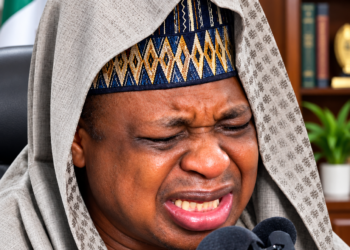
FCT Minister Nyesom Wike has hit back at the All Progressives Congress (APC) Governors Forum over its decision to support only APC candidates at all levels in the 2027 elections, arguing that the governors cannot use President Bola Ahmed Tinubu’s re-election campaign to dictate voters’ choices in other contests.
Wike made the comments during an interview with journalist Charles Aniagolu after the APC governors declared that they would neither support nor endorse political alliances capable of weakening the APC or affecting the party’s candidates at the presidential, governorship and legislative levels.
The position, announced by Imo State Governor and Chairman of the Progressive Governors Forum, Hope Uzodimma, stated that the governors’ campaign commitment would be exclusively to APC candidates. The forum also said it would not support candidates outside the APC at any level.
Wike, however, maintained that his support for Tinubu’s 2027 presidential bid does not amount to an agreement to support APC candidates in other elections.
“With all due respect to you, when I see the people (APC Governors) who read that press conference, they are smart like 419ers, but they are politically lazy, they are neither here nor there,” Wike said in response to the APC governors’ position.
He insisted that he had never approached the Progressive Governors Forum or the APC to negotiate an alliance, saying his decision to support Tinubu in 2023 was based on his own political conviction.
“I have never gone to the Governors Forum to form alliance with Rainbow Coalition. I have never gone to the APC to form an alliance,” he said.
Wike recalled that he and members of the G5 governors supported Tinubu during the 2023 presidential election without entering into a formal arrangement with the APC.
He said his decision was influenced by his belief that the presidency should remain in the South after former President Muhammadu Buhari’s eight years in office.
“We met with the President directly and said we will support you and I have never hidden that,” Wike said, referring to the G5’s engagement with Tinubu.
The minister also challenged Uzodimma’s political argument by pointing to the voting pattern in Imo State during the 2023 elections.
According to Wike, Tinubu received less than 10 per cent of the presidential vote in Imo State, while the APC nevertheless won two senatorial seats in the state and the Labour Party won one.
“As a sitting Governor under an APC Government, you could not give the President 10%. Labour Party scored 360,000 and APC scored 66,000,” Wike said.
His argument was that the same voters who chose different parties in the presidential and National Assembly elections demonstrated that Nigerians can distinguish between different contests on the same ballot.
He made a similar point about Ebonyi State, where he said Tinubu lost the presidential election but the APC won all three senatorial seats.
“The President lost woefully yet they (APC) took all 3 Senators, in an election that was held the same day,” Wike said.
He questioned whether the voting pattern showed confusion among voters or instead demonstrated that electorates were capable of making separate choices for different positions.
“So, in that case what happened? So, the electorates knew how to vote for President for another Party then APC for National Assembly,” he said.
The issue goes to the heart of Wike’s argument over the emerging Rainbow Coalition, which he has repeatedly described as a platform for politicians from different parties who support Tinubu’s re-election without abandoning their own party structures or candidates in other elections.
Wike recently stated that his support for Tinubu was “sacrosanct” but said he never promised that the Peoples Democratic Party (PDP) would stop fielding candidates for governorship, National Assembly and State House of Assembly elections. The Bureau Journal has previously reported his position in Wike’s clarification that his support is for Tinubu, not automatically for APC candidates.
The latest confrontation therefore centres on a fundamental difference between the two political positions. The APC governors are seeking a unified campaign structure in which their support goes to the party’s candidates at every level, while Wike is advocating a presidential alliance that allows politicians to support Tinubu while retaining freedom to back candidates from other parties in state and legislative contests.
The dispute comes as Nigeria’s political parties continue preparations for the 2027 elections. The Bureau Journal’s 2027 elections guide tracks the wider political realignments, electoral reforms and issues expected to shape the next general election.
Wike also rejected any suggestion that he had negotiated his political position with the Progressive Governors Forum.
“I have never one day sat down with Progressive Governors Forum or with their Party, I have no business for that,” he said.
He further questioned the political record of the APC governors who are now insisting on party-wide loyalty, particularly Uzodimma’s record during the 2023 presidential election.
Wike recalled that Uzodimma had supported Ahmad Lawan during the APC presidential primary before Tinubu emerged as the party’s candidate.
He argued that the 2023 results showed that party membership or control of a state government did not necessarily translate into uniform voting patterns across all positions.
The distinction could become increasingly important as parties finalise their candidates for the 2027 elections. The Bureau Journal has already published an emerging list of APC senatorial candidates, while the party continues to manage disputes and competing interests surrounding nominations.
Wike’s comments also come against the backdrop of continuing efforts by APC governors to consolidate their influence over the party’s electoral machinery. Recent developments around the final APC senatorial candidates list have highlighted the role of governors and other party stakeholders in shaping the party’s candidate structure.
The minister’s latest intervention adds another layer to the increasingly complicated alliances developing ahead of 2027, particularly as politicians seek to separate presidential support from contests for governorship and legislative seats.
For Wike, the 2023 election provides evidence that voters can support one party’s presidential candidate and choose candidates from another party for other positions.
For the APC governors, however, the party’s latest position is that its campaign architecture should remain focused on candidates officially sponsored by the APC, with the governors warning against alliances that could create divided loyalty or competing political structures.
The disagreement is likely to remain part of the wider political debate as the 2027 election approaches and politicians continue to negotiate alliances that may look different at the presidential, governorship and legislative levels.
The Bureau Journal will continue to track the evolving political alliances and candidate battles shaping Nigeria’s 2027 elections.
Get breaking news and latest updates directly on WhatsApp