By Abah Benjamin Eneojoh
Abuja
September 25, 2026
There were no campaign banners, no political speeches and no arguments over power. Only grief.
At Gudu Cemetery in Apo, Abuja, the political history of Kogi State seemed to pause on Friday as the remains of former Governor Alhaji Ibrahim Idris, CON, were lowered into the earth.
For a man who spent decades moving through the corridors of public life, his final moments were strikingly quiet: family members mourning, former political associates standing in silence, prayers being offered and old political rivals joining hands with present leaders to say goodbye.
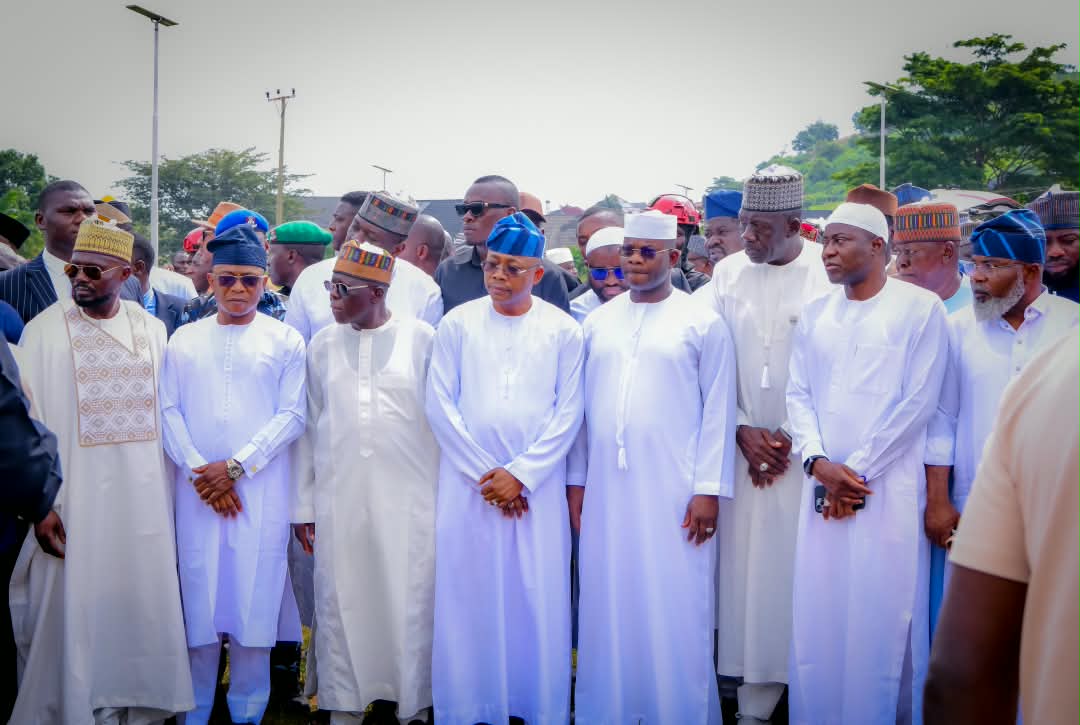
The photographs from the burial captured something words could hardly fully express — the final farewell to a former governor whose name had been woven into Kogi State’s political story for decades.
The Final Journey Home
Alhaji Ibrahim Idris died in the United Kingdom on Sunday, September 20, 2026, at the age of 77.
Five days later, his remains returned to Nigeria for the final rites.
At the International Wing of the Nnamdi Azikiwe International Airport, Abuja, Governor Ahmed Usman Ododo stood alongside former governors, political leaders, members of the Idris family and sympathisers to receive the remains.
It was one of the most poignant moments of the day.
Those who gathered at the airport came from different generations of Kogi politics. But on this occasion, political differences were set aside as they stood together to receive the remains of a man who once occupied the highest political office in the state.
Governor Ododo was accompanied by former Governor Yahaya Adoza Bello, former Governor Idris Ichalla Wada, Deputy Governor Joel Salifu Oyibo, government officials, political leaders and members of the bereaved family.

For a brief moment, the airport became a meeting point between Kogi’s past and present.
Former governors who had succeeded one another in office stood together, not as contestants in a political contest, but as mourners paying their final respects to one of their predecessors.
A Prayer Before the Final Goodbye
From the airport, the remains were taken to the National Mosque, Abuja, where the Janazah prayer was performed in accordance with Islamic tradition.
The Chief Imam of the National Mosque led the prayer as family members, government officials, political associates and sympathisers gathered to pray for the deceased.

It was another deeply solemn scene.
The man whose public career had once involved rallies, government meetings, political negotiations and the machinery of state was now remembered through prayer.
After the Janazah prayer, the remains were taken to Gudu Cemetery in Apo for burial.
At Gudu Cemetery, Kogi Says Goodbye
At the cemetery, the mood became even more subdued.
Family members, former officials, political associates and sympathisers gathered as the final Islamic burial rites were performed.
Then came the moment that made the reality of the loss unmistakable: Ibrahim Idris was committed to the earth.
There were prayers. There were bowed heads. There were quiet reflections.
And there was the unmistakable sense that a chapter had ended.
For those who knew him personally, worked with him or followed his political career, the burial was more than the conclusion of a funeral programme. It was the closing of an era.
Ododo, Bello and Wada Stand Together
Perhaps one of the most striking images from the funeral was the gathering of Governor Ahmed Usman Ododo with former governors Yahaya Bello and Idris Wada.
Each belongs to a different chapter of Kogi’s political history.
Wada succeeded Ibrahim Idris as governor. Bello later became governor. Ododo now occupies the office.
Yet at the funeral, the succession of political power became almost secondary.

The three stood together to honour the man whose administration preceded both their own time in the Kogi Government House.
The image offered a powerful reminder of the continuity of public office: one governor leaves, another takes over, and eventually all become part of the history of the institution they once led.
A State Government Takes Responsibility for the Farewell
The burial followed several days of mourning and official activities initiated by Governor Ododo after the announcement of Ibrahim Idris’ death.
Shortly after the death was announced, Governor Ododo visited the bereaved family at their Abuja residence, accompanied by former Governor Yahaya Bello and senior government officials.
The governor subsequently declared three days of mourning in honour of the former governor and directed that the national and Kogi State flags be flown at half-mast across government offices and designated public institutions.
The state government also constituted a high-powered burial committee headed by Deputy Governor Joel Salifu Oyibo to coordinate the funeral arrangements.
The committee handled areas including prayers, mobilisation, media, venue and protocol, tomb preparation, finance and security.
The government also announced that it would take responsibility for the burial and accord Ibrahim Idris a state burial.
The Man Kogi Came to Remember
Ibrahim Idris became Governor of Kogi State in 2003 under the Peoples Democratic Party.
His first tenure was interrupted by the legal battle over the 2007 governorship election. Following a court-ordered rerun in 2008, he returned to office and remained governor until January 2012.
He was succeeded by Captain Idris Ichalla Wada.
The Bureau Journal reported his death on September 20, recalling his emergence as governor in 2003, the 2007 election dispute and his return to office after the 2008 rerun.
His nearly nine years in office placed him among the longest-serving governors in Kogi’s Fourth Republic history.
His administration was associated with interventions in infrastructure, education, healthcare and housing, areas referenced by the Kogi State Government in tributes following his death.

From Government House to Gudu Cemetery
Politics had defined much of Ibrahim Idris’ public life.
But in death, the photographs from his final journey told a different story.
They showed family members mourning their patriarch. They showed political associates standing quietly. They showed former governors gathered together. They showed a state government taking responsibility for the farewell. And they showed a cemetery where the trappings of political office no longer mattered.
The man who once occupied the Kogi Government House was now being returned to the earth.
That final image is perhaps the most powerful of them all.
A Political Era Comes to an End
The death of Ibrahim Idris closes a significant chapter in Kogi State’s political history.
His career stretched from the early years of the Fourth Republic through years of political contest, election disputes, governance and party realignments.
He governed Kogi through a period when the state was still navigating the political structures of the young Fourth Republic, and his name remained part of the state’s political conversation long after he left office.
The Bureau Journal has continued to document the evolution of Kogi’s leadership under Governor Ahmed Usman Ododo, providing a picture of how the state has moved through successive political generations.
The funeral brought several of those generations into one place.
Former leaders came to honour a former leader. Family members came to bury a father and patriarch. Friends came to say goodbye. And a state came to mourn one of its former chief executives.

The Last Picture
As the crowd gradually dispersed from Gudu Cemetery, what remained was the quietness that follows a final goodbye.
Ibrahim Idris had returned home.
He had been received at the airport by leaders of the state he once governed. He had been prayed for at the National Mosque. He had been accompanied to the cemetery by family, friends, former governors, the sitting governor and dignitaries.
And finally, he was laid to rest.
His political chapter is now closed, but the photographs of his final journey will remain as a record of the day Kogi’s political family gathered in Abuja to say goodbye.
May Almighty Allah forgive his shortcomings, accept his good deeds and grant him Aljanat Firdaus.
Get breaking news and latest updates directly on WhatsApp