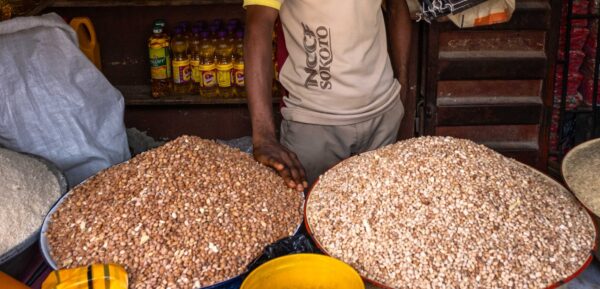
The National Agency for Food and Drug Administration and Control (NAFDAC) has raised concerns over pesticide residues exceeding permitted safety limits in some bean samples, while announcing the interception of 67,428 litres of banned paraquat in Kebbi State.
NAFDAC Director-General, Prof. Mojisola Adeyeye, disclosed the findings at a media briefing in Lagos on pesticide use in agricultural produce. She warned that the circulation of prohibited chemicals and the misuse of approved products threatened consumers, farmers and the environment.
According to Adeyeye, a recent market study detected excessive residues of pyrethroids and dimethoate in some samples of beans, highlighting concerns about chemicals used to preserve harvested produce.
“NAFDAC is not against the responsible use of pesticides. Rather, the agency seeks to ensure that pesticides sold or used in Nigeria are safe, approved and compliant with regulatory requirements,” she said.
Dimethoate Not Approved for Preserving Harvested Beans
Adeyeye explained that dimethoate was not approved for preserving harvested beans against storage pests such as weevils.
She stressed that approval to use a chemical on crops in the field did not automatically authorise its application to harvested food.
While certain pyrethroids could be used for post-harvest storage under approved conditions, users must follow the prescribed instructions and observe the required waiting period before consumption, she said.
The findings concern some samples examined in the study; the agency did not present them as evidence that all beans sold in Nigeria were contaminated.
Beans remain an important household food item, featuring in The Bureau Journal’s reporting on food prices and available inflation figures across Nigeria and changes in food costs in Kogi State.
Major Pesticide Interceptions in Kebbi and Other States
In Kebbi, NAFDAC intercepted 5,619 cartons containing 67,428 litres of paraquat, alongside 500 cartons of atrazine products.
Adeyeye also said the agency seized banned agrochemicals worth more than ₦800 million across Ogun, Ondo, Osun and Oyo states in 2025.
Between September 2024 and July 2026, operations in the North-West resulted in the seizure, interception or recovery of 2,974 cartons of paraquat-containing pesticides valued at approximately ₦148.7 million.
Another 120 cartons containing chlorpyrifos, valued at more than ₦17 million, were intercepted during the same period.
| Location or operation | Reported seizure or enforcement action | Reported value |
|---|---|---|
| Ogun, Ondo, Osun and Oyo, 2025 | Banned agrochemicals | More than ₦800 million |
| North-West, September 2024–July 2026 | 2,974 cartons of paraquat-containing pesticides | Approximately ₦148.7 million |
| North-West, September 2024–July 2026 | 120 cartons of chlorpyrifos-containing pesticides | More than ₦17 million |
| Separate Kebbi operation | 5,619 cartons containing 67,428 litres of paraquat; 500 cartons of atrazine products | Not stated |
| Bichi, Kano, July 2026 | Four unauthorised pesticide and agrochemical manufacturing facilities sealed | Not stated |
Source: NAFDAC briefing. The figures are presented separately because the statement does not establish whether any operational totals overlap.
At the sealed facilities in Bichi, officers reportedly found unlabelled products, bulk chemicals and packaging materials associated with unauthorised production.
Adeyeye said suspects had been arrested during enforcement operations and that one case was undergoing prosecution.
Paraquat, Chlorpyrifos and Atrazine Phase-Out Completed
The Director-General said the phase-out periods for pesticides containing paraquat, chlorpyrifos and atrazine ended on January 1, 2026.
According to her, the products could no longer legally be manufactured, imported, distributed, sold or used in Nigeria under the agency’s completed regulatory measures.
She attributed their continued circulation partly to illegal importation, unauthorised local production and distribution through unapproved channels.
“These interceptions after the effective date of the ban indicate that the challenge extends beyond residual stocks to illegal importation, unauthorised local production and distribution,” she said.
The enforcement concerns also highlight the importance of border inspections. In a separate operation involving illicit drugs, Customs recently reported the interception of opioids and arrests of suspected traffickers in Taraba.
NAFDAC Lists Dangerous Pesticide Practices
Adeyeye warned that risks arose not only from banned products but also from the incorrect application of approved pesticides.
She identified practices that could expose people and the environment to harmful chemicals:
- Applying quantities above the recommended dosage.
- Using products on crops or pests for which they were not approved.
- Harvesting before the prescribed pre-harvest interval.
- Mixing pesticide products improperly.
- Storing chemicals alongside food, animal feed or household items.
- Reusing empty pesticide containers for domestic purposes.
- Disposing of chemical residues and containers improperly.
“Food safety begins on the farm,” Adeyeye said.
She urged farmers to purchase approved products from recognised dealers, read labels, apply recommended quantities and observe all prescribed safety precautions.
The emphasis on responsible production is relevant to agricultural investment programmes, including plans for cashew processing and agricultural development in Kogi and state initiatives covering farm support and reforms.
Agency Restricts Small Dichlorvos Packs
Adeyeye also disclosed that NAFDAC had restricted the 100ml pack size of dichlorvos, prohibiting its importation, manufacture and sale in open markets or supermarkets following concerns about misuse on agricultural produce and its use in suicide.
She said other permitted pack sizes remained subject to applicable regulatory controls.
The agency’s pesticide review began in 2022 and considered scientific evidence, registered active ingredients, expert input, environmental risks and regulatory requirements.
More Than 2,000 Agro-Input Dealers Trained
NAFDAC said it had trained more than 2,000 agro-input dealers on responsible pesticide handling and application and was expanding its investigation and enforcement zonal offices from three to six.
Other measures include product registration, scientific assessment, inspections, border checks, market surveillance, laboratory testing and action against illegal manufacturers and distributors.
Adeyeye said the agency also provided free interim testing for export products to encourage compliance and reduce the risk of rejection in destination markets.
Deputy Director of Veterinary Medicine and Allied Products, Dr. Idayat Mudshiru, said NAFDAC continued to engage farmers and industry stakeholders, including CropLife, on safe pesticide use.
The agency urged manufacturers, importers, distributors and farmers to meet their respective responsibilities across the agricultural supply chain.
“No business interest or desire for profit will justify the illegal importation, distribution or sale of banned or non-compliant pesticides,” Adeyeye said.
Get breaking news and latest updates directly on WhatsApp