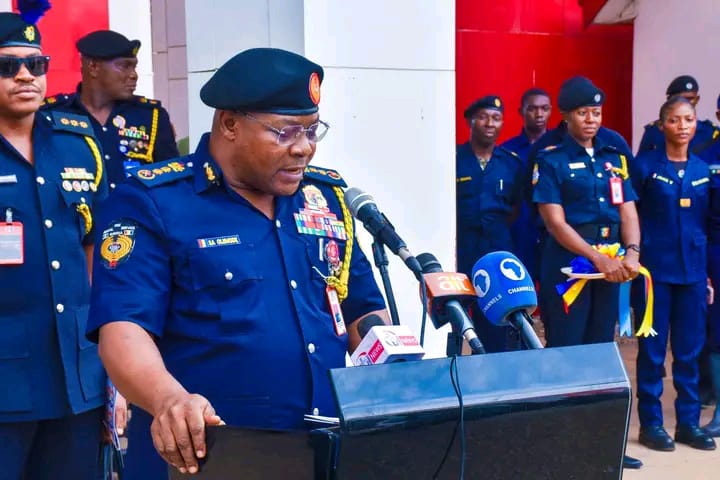
In every public institution, leadership is measured not only by the authority attached to an office but by the courage, vision and sense of responsibility with which that authority is exercised. In the Federal Fire Service, the emergence of Dr. Samuel Adeyemi Olumode as Controller-General has brought renewed attention to the importance of professional leadership in protecting lives, property and national assets.
Appointed by President Bola Ahmed Tinubu and assuming office on August 14, 2025, Olumode came into the position with extensive experience from both the Federal Capital Territory Fire Service and the Federal Fire Service. His career progression through operational, administrative and leadership positions has provided him with practical experience in the demanding business of emergency response and public safety.
What distinguishes Olumode’s leadership is his emphasis on moving fire safety beyond emergency response to prevention and preparedness. Under his leadership, the Federal Fire Service has placed greater emphasis on public awareness, professional training, equipment rehabilitation, strategic communication and collaboration with stakeholders.
In 2026, Olumode disclosed that more than 40 firefighting appliances had been rehabilitated, while 22 modern appliances were ready for commissioning and deployment. He also reported that more than 700 cadet officers had undergone basic firefighting training and had been deployed across various commands.
These developments are significant because modern firefighting requires more than bravery. It requires trained personnel, functional equipment, rapid response systems, public cooperation and continuous institutional improvement.
Olumode has also consistently advocated a preventive approach to fire safety. In September 2026, he warned that weaknesses in building design, construction practices and maintenance continue to expose Nigerians to avoidable fire risks. He called for fire-safety considerations to begin from the design stage of buildings rather than being treated as an afterthought.
His message is simple but profound: preventing a fire disaster is just as important as responding effectively when one occurs.
Another notable aspect of his leadership is his recognition that the Fire Service cannot operate effectively without the cooperation of the public. He has repeatedly called on motorists to give emergency vehicles the right of way and urged citizens to keep access routes clear during emergencies. He has also advocated greater collaboration between government, communities, businesses and private organisations in expanding fire-safety infrastructure.
For a country experiencing rapid urbanisation and increasingly complex emergencies, this broader understanding of firefighting is important. Firefighters are no longer dealing only with conventional fires; they can be called upon during building collapses, explosions, floods and other emergencies.
Olumode’s leadership has therefore placed emphasis on preparing personnel for the changing nature of emergency response. His administration has also pursued stronger communication structures within the Service, including training for Public Relations Officers across the 36 states and the Federal Capital Territory.
Beyond his professional responsibilities, Olumode’s journey also carries significance for Kogi State, where he hails from. His return to the state in 2026 attracted traditional and community engagements, reflecting the pride associated with seeing an indigene occupy a prominent national position.
For many Nigerians, the real test of leadership is the difference it makes in the lives of ordinary people. In the case of the Federal Fire Service, every improved response, every trained firefighter, every rehabilitated appliance and every fire prevented represents lives and property potentially saved.
This is why the story of Samuel Adeyemi Olumode deserves recognition—not merely as that of a man occupying the highest professional office in Nigeria’s Fire Service, but as that of a public servant entrusted with one of the country’s most important responsibilities.
At a time when Nigeria needs institutions that are professional, responsive and prepared for emerging challenges, the Fire Service requires leadership capable of combining experience with innovation.
Olumode’s tenure is still unfolding, but the emphasis on prevention, preparedness, operational capacity, personnel development and public engagement provides important markers by which his stewardship can be understood.
Ultimately, the greatest tribute to a fire service leader is not the number of fires fought, but the number of lives protected and disasters prevented.
And that is the enduring responsibility that Dr. Samuel Adeyemi Olumode carries as he leads the Federal Fire Service in its mission to safeguard Nigerians.
By Comrade Daniel Ameh
Get breaking news and latest updates directly on WhatsApp