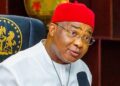
The All Progressives Congress (APC) Governors Forum has delivered a message that could significantly reshape the 2027 political battle in Kogi East: APC members are not expected to support candidates outside the party.
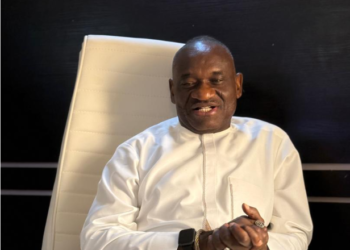
The position could come as an important boost for Dr Joseph Ameh Erico, the APC senatorial candidate for Kogi East, as he prepares for what is expected to be a closely watched contest for the district’s Senate seat.
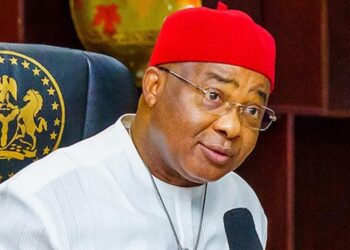
The Progressive Governors Forum, speaking through its chairman, Imo State Governor Hope Uzodimma, said APC governors would neither participate in nor support political alliances capable of weakening the ruling party or undermining its candidates.
“The APC Governors Forum unanimously resolved that its members will not participate in, support or endorse any alliance or political arrangement capable of undermining the re-election of Mr President, weakening the APC or adversely affecting any candidate of the party at all levels,” Uzodimma said.
He added that no arrangement creating “confusion, divided loyalty, or competing interests” within the party would be entertained.
Why the Declaration Matters for Erico
At face value, the declaration is a national APC position. But its implications could be particularly important in constituencies such as Kogi East, where the ruling party has experienced intense internal competition following its senatorial primary.
Erico emerged from that primary as the APC candidate after defeating incumbent Senator Isah Jibrin, popularly known as Echocho, in the contest.
Echocho subsequently rejected the outcome and declared himself the authentic APC candidate, creating uncertainty around the party’s representation in the district. Premium Times reported at the time that the senator maintained that he remained the rightful candidate despite the primary result.
The APC’s position has since become clearer. The Bureau Journal previously reported that the party publicly listed Erico as its Kogi East senatorial candidate, while the latest INEC candidate list also includes Ameh Erico Joseph of the APC among those contesting the Kogi East Senate seat in 2027.
That makes the governors’ latest declaration politically significant for Erico: the party leadership is now explicitly warning its structures against supporting alternative arrangements that could undermine an official APC candidate.
From Primary Victory to Party Backing
Erico’s journey to the APC ticket has been one of the more closely followed political developments in Kogi ahead of the 2027 elections.
He defeated Echocho during the May 2026 primary, with reports indicating that he secured the highest number of votes across the nine local government areas of Kogi East. The Guardian listed the contest among the notable APC primary battles in which sitting senators lost their return tickets.
The outcome, however, did not immediately end the political contest.
Echocho’s rejection of the result, coupled with efforts by influential political actors to assist senators who lost their primaries, left open the possibility that the Kogi East ticket could become part of a wider political negotiation.
The Bureau Journal reported in August that Senate President Godswill Akpabio was working to support lawmakers who lost their party primaries, with Echocho among those affected. That development briefly raised questions about whether Echocho could find another route back to the Senate.
But the political landscape has continued to move in Erico’s favour.
INEC Listing Adds Another Layer of Clarity
The latest development is not merely an internal APC announcement.
INEC’s final list of senatorial candidates for Kogi confirms Ameh Erico Joseph as the APC candidate for Kogi East, alongside candidates from other political parties.
That listing gives Erico a significantly stronger formal position as the election approaches.
It also means that the political conversation has shifted from whether Erico would carry the APC ticket to whether he can consolidate the party’s structure behind his candidacy and defeat the opposition candidates at the general election.
For the APC, the governors’ latest declaration adds another layer of institutional backing to that process.
The Yahaya Bello Factor
Erico’s political journey, however, has not been without complications.
His name has become associated with the political network surrounding former Kogi State Governor Yahaya Bello, an association that has generated both support and political questions around his candidacy.
Erico has maintained political links with Bello, and reports around the APC primary noted the support of the former governor and his political structure. A group that celebrated Erico’s primary victory also publicly commended Bello for his role in political mobilisation and inclusiveness.
But Erico’s political history is broader than his relationship with the former governor.
Before becoming an APC candidate, he was identified as a PDP chieftain and contested the Kogi governorship in the 2019 political cycle. In a 2017 interview, he criticised Bello’s administration and argued for a return of the PDP to power in Kogi.
His subsequent movement into the political orbit of the former governor illustrates just how dramatically alliances in Kogi have shifted ahead of 2027.
That history could become both an asset and a vulnerability.
Can Erico Turn Party Backing Into Grassroots Support?
The central political question for Erico now is not simply whether the APC recognises him as its candidate. It is whether he can translate the party’s formal backing into a united grassroots campaign across Kogi East.
The district comprises nine local government areas and has historically been one of the most politically competitive zones in Kogi State.
Erico’s supporters have portrayed his primary victory as evidence of his grassroots strength. One August profile described him as having built a political network across the nine local government areas and highlighted his focus on security, jobs, youth empowerment and agriculture.
But winning an internal party contest and winning a general election are different political assignments.
Erico will have to contend with opposition candidates, dissatisfied APC members, former supporters of rival aspirants and voters whose choices may not necessarily follow party structures.
APC Unity Becomes Critical in Kogi East
The latest declaration by the APC Governors Forum could therefore have a deeper meaning in Kogi East.
If the party’s governors and other senior leaders enforce the position that official APC candidates should receive the party’s full support, Erico could benefit from a more disciplined campaign structure.

That would matter in a district where internal divisions could otherwise split the ruling party’s vote.
The Bureau Journal previously reported on the broader uncertainty surrounding APC senatorial candidates after the primaries, when several defeated incumbents continued lobbying for political alternatives. The report examined why some governors’ preferred candidates could still retain their places on the party’s final senatorial list.
The situation has since evolved, with Erico now appearing on the final candidate list.
A Different Test After Echocho
Erico’s challenge is now to move beyond the politics of the primary.
The contest against Echocho was essentially an internal APC battle. The 2027 general election will be different.
He will need to persuade voters who may have supported Echocho, appeal to undecided voters and defend the APC’s record in the district while presenting himself as a candidate capable of representing Kogi East effectively in the Senate.
His association with the Bello political network will also remain part of the conversation, particularly among voters and political actors who have strong opinions about the former governor’s eight-year tenure.
That association may provide access to an established political structure, but it also means Erico could inherit some of the political arguments surrounding the former governor.
The Bigger 2027 Picture
The APC governors’ declaration comes at a time when political alliances are being renegotiated across Nigeria ahead of the 2027 elections.
The immediate target of the governors’ warning appears to be any political arrangement capable of creating competing structures within the ruling party, particularly as opposition figures and political coalitions seek to build broader alliances ahead of the presidential election.
For APC candidates such as Erico, however, the message is straightforward: the party expects its governors and political structures to support those carrying the official APC flag.
That could be particularly valuable in Kogi East, where Erico has spent months moving from the uncertainty of a disputed primary to the much firmer ground of an official candidacy.
Erico’s Moment Has Arrived — But So Has the Hard Part
Erico now has something that was not guaranteed immediately after the APC primary: a clearer institutional path to the general election.
He has the APC ticket. His name appears on the INEC candidate list. The party’s governors have publicly declared that APC structures should not support candidates outside the party.
But none of those developments guarantees victory.
The harder political task begins now — reconciling the APC’s competing interests in Kogi East, maintaining grassroots mobilisation and convincing voters that his candidacy represents more than the continuation of an established political network.
His association with Yahaya Bello may remain one of the most discussed aspects of his political identity, but the 2027 election will ultimately test whether Erico can build a political identity strong enough to stand on its own.
For now, however, the direction from the APC Governors Forum gives him a clear message from the ruling party: the official APC candidate is the candidate the party expects its structures to support.
Get breaking news and latest updates directly on WhatsApp