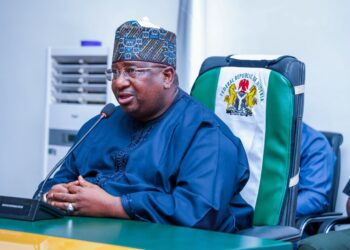
Kebbi State is placing greater emphasis on internally generated revenue as Governor Nasir Idris’ administration seeks to strengthen the state’s financial capacity and reduce dependence on federal allocations.
For Aliyu Umar Mohammed, the effort goes beyond tax collection. He sees the administration’s push to improve internally generated revenue (IGR) as an important part of building a more financially resilient Kebbi State.
Mohammed, who is associated with the Kebbi State Internal Revenue Service (KBIRS), argues that a stronger and more coordinated revenue system could give the state greater room to finance infrastructure, improve public services and support its wider development agenda.
Why Kebbi Is Looking Beyond Federal Allocations
The importance of IGR featured prominently in Governor Nasir Idris’ presentation of the 2026 Appropriation Bill before the Kebbi State House of Assembly on November 27, 2025.
According to Mohammed, the governor emphasised the need to strengthen the state’s internally generated revenue so that it can complement federal allocations in funding the 2026 budget.
The argument is straightforward: while statutory allocations remain an important source of funding for states, a stronger internally generated revenue base can provide greater fiscal flexibility and help governments plan with more predictable locally generated resources.
That broader fiscal challenge is not unique to Kebbi. Across Nigeria, states continue to look for ways to expand their own revenue sources while improving collection efficiency and reducing leakages.
The Bureau Journal has previously examined questions surrounding Nigeria’s wider economic pressures and the need for stronger financial management as households and institutions adjust to a difficult economic environment.
The Tax Reform Behind Kebbi’s Revenue Push
One of the measures highlighted by Mohammed is the introduction of Executive Bill 8, the Kebbi State Harmonized Taxes and Levies (Approval List for Collections) Bill 2025 before the state House of Assembly.
The proposed legislation is aimed at streamlining and harmonising the collection of taxes and levies across the state.
Its stated objective, as described in the supplied commentary, is to reduce duplication and multiple taxation while creating a more coordinated framework for revenue collection.
For businesses and residents, the effectiveness of such a reform will depend not simply on how much revenue government collects, but also on whether the system becomes clearer, more predictable and easier to comply with.
A well-designed revenue framework can help government identify who is liable to pay particular taxes, which agency is responsible for collection and how revenues are accounted for.
That can potentially reduce the confusion and duplication that often accompany fragmented tax collection systems.
Why Tax Harmonisation Matters to Businesses
Multiple taxes and levies can become a significant burden when different government agencies or authorities seek payment for overlapping obligations.
For Kebbi’s businesses, therefore, harmonisation could matter as much for certainty as for the amount ultimately paid.
A single, transparent system can make it easier for businesses to understand their obligations, plan their expenses and remain compliant with the law.
For government, the benefit is potentially greater visibility over the revenue base and better control over collection processes.
The Bureau Journal has also reported on broader efforts to encourage investment and economic activity in northern Nigeria, including the Jigawa investment initiative that attracted a ₦7.5 billion proposal.
KBIRS Takes Centre Stage
Mohammed credits the Kebbi State Internal Revenue Service with a more aggressive approach to tax administration under its leadership.
He specifically commended Dr. Aminu Abdullahi, FCNA, FCPA, FCTI and FCTrFA, for what he described as renewed efforts to improve tax collection and administration in line with Governor Idris’ vision.
According to Mohammed, KBIRS is focusing on innovative collection strategies, broader engagement with taxpayers and the identification of new legitimate revenue opportunities.
The objective, he said, is to broaden the state’s revenue base, reduce leakages and improve compliance without imposing unnecessary burdens on citizens and businesses.
The Bigger Question: Can Higher IGR Translate Into Better Services?
Increasing IGR is only one part of the equation.
The ultimate test for any revenue reform is what happens after the money is collected.
For Kebbi residents, stronger internally generated revenue would become meaningful if additional resources translate into better roads, healthcare, education, water infrastructure, agricultural support, employment opportunities and other public services.
That makes transparency and accountability just as important as collection efficiency.
If revenue increases while leakages decline and public spending becomes more effective, the state could have greater capacity to pursue long-term development projects.
The Bureau Journal has previously reported on Kebbi State Government’s broader development efforts and its engagement with traditional institutions, reflecting the wider policy conversation around development in the state.
Building a More Self-Reliant Kebbi
Mohammed’s central argument is that fiscal self-reliance should form part of Kebbi’s development strategy.
A state that can efficiently mobilise legitimate local revenue has greater scope to complement federal resources and respond to its own priorities.
That does not mean replacing federal allocations. Rather, the goal is to create additional fiscal capacity that can strengthen the state’s ability to implement its development plans.
The approach also fits into the broader economic question of how Nigerian states can create stronger local economies rather than relying predominantly on transfers from the federation account.
The Bureau Journal has previously examined Nigeria’s changing economic landscape, including the country’s historical role in international finance and development in its report on Nigeria’s $240 million loan to the World Bank.
What Nasir Idris’ Revenue Vision Could Mean for Kebbi
The revenue reforms now being pursued in Kebbi will ultimately be judged by their results.
For the administration of Governor Nasir Idris, the challenge is to expand the state’s revenue base while maintaining public confidence, protecting legitimate taxpayers and ensuring that additional resources are efficiently deployed.
For KBIRS, that means combining stronger enforcement with taxpayer education, digital systems, accurate records and professional administration.
For residents and businesses, it means having a tax system that is transparent, predictable and free from unnecessary duplication.
And for the state as a whole, success would mean converting improved revenue mobilisation into tangible development.
Mohammed’s message is therefore broader than a call for higher tax receipts. His argument is that a stronger revenue system can provide the financial foundation for a stronger Kebbi.
Whether that vision delivers the desired results will depend on implementation, accountability and the extent to which increased internally generated revenue ultimately reaches the projects and services that matter to the people.
About the Author: Aliyu Umar Mohammed is associated with the Kebbi State Internal Revenue Service.
September 5, 2026
Get breaking news and latest updates directly on WhatsApp