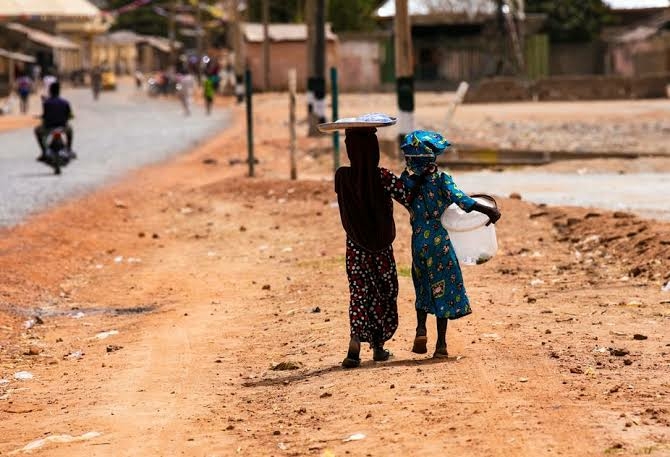
Street hawking remains a source of income for vulnerable families in Lokoja, Kogi State, with some adolescent girls missing out on secondary education because their parents cannot afford school-related expenses, according to a report by THE BUREAU JOURNAL.
The report found that some children from low-income households hawk goods to help support their families, while others have stopped attending school because of financial difficulties.
The situation persists despite government efforts to return out-of-school children to classrooms and improve educational opportunities for vulnerable girls.
Widow Relies on Children’s Earnings
Shefiya Abubakar, a widow living in the Kabawa area of Lokoja, told LEADERSHIP Sunday that she depended on petty trading and the proceeds from her children’s hawking to support her household.
Abubakar said she had four children and no regular source of income following her husband’s death. She sells tomatoes and pepper to provide for the family.
“I’m a widow with four children. I have no job. I take care of my children through selling tomatoes and pepper. But I’m planning to send my eldest daughter to school,” she said.
She added that her other children would continue helping the family until its financial circumstances improved.
Abubakar expressed hope that she would eventually be able to enrol her eldest daughter in school and reduce the household’s dependence on the children’s earnings.
Girl Drops Out After Primary School
Nanahawa Kadiri, one of the girls engaged in hawking in Lokoja, said she stopped attending school after completing primary education because her parents could not afford to enrol her in secondary school.
According to Kadiri, her father works at night while her mother sells goods at Pata Market. She initially helped her mother after school but eventually stopped attending classes.
She said many of her former classmates had progressed to secondary school while she remained at home, hawking to support her family.
“My mates are now in secondary school. I want to join them. Mummy said I will go to secondary school when she and my father save some money,” she said.
Her experience illustrates how household financial pressures can interrupt a child’s education, particularly at the transition from primary to secondary school.
Concerns about access to safe and functional learning facilities have also emerged elsewhere in the state. The Bureau Journal reported on an appeal to rehabilitate Alalodu Secondary School in Ejuku, where residents raised concerns about deteriorating school infrastructure.
Kogi Government Highlights AGILE Education Programme
The Kogi State Government, through the Adolescent Girls Initiative for Learning and Empowerment (AGILE) Project, has reaffirmed its commitment to improving educational opportunities and life outcomes for out-of-school adolescent girls.
The programme is designed to help more girls return to school and address barriers that prevent them from accessing education, according to the information supplied about the initiative.
The project targets adolescent girls between the ages of 13 and 24, including out-of-school girls, vulnerable girls, girls living with disabilities and those in rural and urban communities across Kogi State.
Alhaji Ahmed Tijani Oricha, the Kogi AGILE Project State Coordinator, said the initiative seeks to help girls overcome social, economic and cultural barriers that hinder their education and personal development.
The programme is part of wider efforts to improve educational access in the state. The Bureau Journal previously reported on the distribution of AGILE-supported secondary school projects across Kogi State, including calls for greater transparency in the selection of beneficiary locations.
School Access and Affordability Remain Important
While education programmes can help expand access to learning, the experiences described by families in Lokoja highlight the financial pressures that can prevent children from enrolling in or completing school.
For households without stable earnings, the cost of school-related needs can compete with spending on food and other essentials. Where children contribute to family income, returning to school may require support that addresses both educational expenses and household vulnerability.
The Bureau Journal’s guide to assessing learning conditions in Kogi public primary schools examines the importance of looking beyond school buildings to the facilities and services pupils need to learn effectively.
Financial assistance is another part of the wider education picture. The state government has also approved a bursary programme for Kogi students, although that initiative concerns students’ support and does not, on its own, establish that the costs facing out-of-school adolescent girls have been addressed.
The government’s youth development agenda has also included technology and skills initiatives. The Bureau Journal reported on a Kogi youth technology fellowship programme aimed at equipping young people with digital skills. Such programmes address a different need from basic school access but reflect the broader importance of expanding opportunities for young people.
Support Needed to Keep Girls in School
The accounts of Abubakar and Kadiri point to the difficulty some families face in balancing immediate economic needs with their children’s education.
For the AGILE Project to reach girls who have already left school, identifying out-of-school children and understanding the barriers facing their households will be important. The experiences described in Lokoja suggest that financial hardship can be a major obstacle for some families.
Returning girls to school may therefore require sustained engagement with parents and communities, alongside appropriate educational support and measures that make attendance more manageable for vulnerable households.
The Kogi State Government has stated its commitment to expanding educational opportunities through AGILE. The experiences reported in Lokoja underscore the importance of ensuring that such interventions reach girls who have left school because their families cannot afford the costs.
For girls like Kadiri, the immediate hope is to return to the classroom and continue their education alongside their former classmates. Whether that becomes possible will depend on the support available to her family and the effectiveness of efforts to reach children who remain out of school.
Get breaking news and latest updates directly on WhatsApp