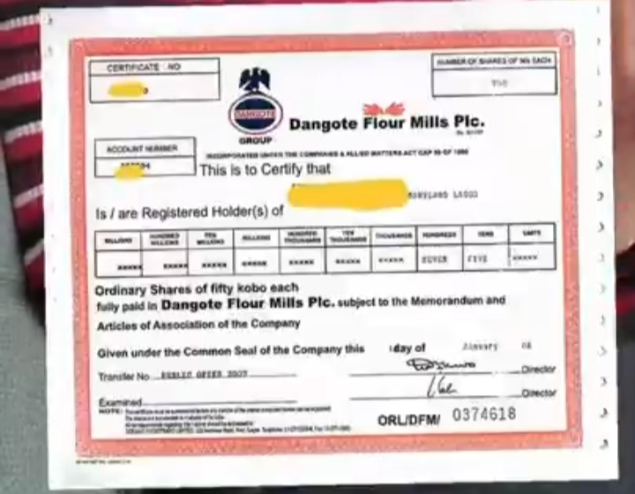
A Nigerian woman has sparked a fresh conversation about the realities of long-term stock investment after revealing what she said her Dangote Flour Mills shares were worth years after she bought them.
The woman shared her experience in a video while reacting to a recent discussion by VeryDarkMan about disappointing returns allegedly experienced by some investors in Dangote-related shares.
According to her account, she purchased Dangote Flour Mills Plc shares in 2007 for about ₦11,000.
She held onto the investment for years, apparently expecting that the value of the shares would grow significantly over time.
Then, after about 16 years, she decided to find out exactly what her investment had become.
The figure she said she was given left her stunned.
Her shares, she claimed, were worth only about ₦35,000.
‘I Would Have Bought Shoes’
Holding up the old share certificate, the woman expressed disbelief at the amount.
After waiting more than a decade, she said the increase in value was nowhere near what she had imagined when she first invested.
Her frustration was summed up in a remark that has since attracted attention online: if she had known how little the investment would ultimately be worth, she said she might simply have used the original ₦11,000 to buy a good pair of shoes.
The certificate remained as a physical reminder of an investment she had made many years earlier.
But for her, the bigger issue was what happened to the purchasing power of the money she had committed to the shares for so long.
What Happened to Dangote Flour Mills?
There is an important piece of history behind the certificate.
Dangote Flour Mills was a publicly quoted company, but its ownership and corporate structure changed substantially after the woman bought her shares.
In 2012, Dangote Industries Limited sold a 63.35 per cent stake in Dangote Flour Mills to South African company Tiger Brands in a deal valued at about $181.9 million at the time.
Tiger Brands later agreed to sell the business back to Dangote Industries Limited in 2015 after difficulties with the Nigerian operation.
The company’s story took another major turn in 2019 when Olam International, through Crown Flour Mills, agreed to acquire Dangote Flour Mills.
Shareholders eventually approved the takeover at ₦24 per share, and the company was subsequently delisted from the Nigerian Stock Exchange in November 2019.
Olam’s acquisition was ultimately completed for about ₦120 billion, with Crown Flour Mills acquiring the outstanding shares under the scheme of arrangement.
That history is important because a shareholder’s experience with the original Dangote Flour Mills shares cannot simply be understood by looking at today’s stock-market price. The company ceased trading as a listed entity following the acquisition.
Why Her Story Has Got People Talking
The woman’s experience touches on a question that many first-time investors rarely ask when buying shares: what will the investment actually be worth after inflation, corporate restructuring, dividends, fees and changes in ownership are taken into account?
An investment can rise in nominal naira terms and still deliver a disappointing real return if prices have risen much faster during the same period.
That distinction matters particularly for Nigerians who bought shares during the wave of retail investing that surrounded the Nigerian stock market in the 2000s.
For anyone considering an investment today, the lesson is not simply to buy or avoid a particular company’s shares. Investors need to understand what they are buying, how the company makes money, whether dividends are paid, what corporate actions could affect their holdings and how inflation can change the real value of returns.
The Bureau Journal has also examined the risks Nigerians face in the investment space, including the warning signs associated with fraudulent investment platforms. How to Avoid Online Investment Scams in Nigeria
The Billionaire Question
In the video, the woman went beyond her personal experience and criticised the way wealthy business owners raise capital from ordinary Nigerians.
She argued that money collected from the public helps build large businesses and fortunes while small investors can sometimes feel that they have received little in return.
Those comments are her view, rather than an established finding about Dangote or Dangote Flour Mills.
The history of Dangote Flour Mills is more complicated than that interpretation suggests. The company went through changes in ownership, financial difficulties, restructuring and ultimately a takeover and delisting.
That is why individual investors’ experiences can differ depending on when they bought their shares, the number of shares they held, corporate actions affecting the company and whether they received dividends or other proceeds along the way.
A Certificate That Became a Conversation
For the woman, however, the numbers told a much simpler story.
She put about ₦11,000 into the investment in 2007.
Years later, she said she discovered a value of roughly ₦35,000.
On paper, that is an increase in naira terms. But after more than a decade and a half, she clearly expected the difference to be much more substantial.
Her story has now become part of a wider online conversation about the experiences of ordinary Nigerians who bought shares years ago and later wondered what became of their investments.
The Bureau Journal has continued to examine investment, wealth-building and financial issues affecting Nigerians, including how investors should think about debt, assets and risk. What Robert Kiyosaki’s $1.2 Billion Debt Really Means
For readers trying to understand where investment opportunities are emerging today, The Bureau Journal has also reported on new investment initiatives in sectors ranging from deep offshore oil and gas to agriculture. What Tinubu’s $50 Billion Deep Offshore Investment Plan Means for Ordinary Nigerians Jigawa Economic Summit’s ₦7.5 Billion Investment Proposal Kogi’s Proposed Cashew Processing Investment
But perhaps the most striking part of this particular story is the old piece of paper she held up to the camera.
The certificate represented an investment that was real.
The ₦11,000 was real.
The years of waiting were real.
And according to her account, when she finally checked what those shares were worth, the result was nowhere near what she had imagined.
Watch the video and hear her tell the story in her own words.
Get breaking news and latest updates directly on WhatsApp